
Who chooses your book, and who reads it?
People select books for different reasons. And people read books for different reasons. Selecting a book and reading one are not the same thing: you might select a book for someone else to read, and you might read a book that was selected for you. For most people, it’s a rare privilege to select what you read.
A person might select a book:
- for themselves (a novel for their holiday, for instance)
- for others as gifts (they buy a bird book for a bird-loving friend, or choose a book for their book club)
- for others as an intervention (they prescribe a book for a class, or as shared learning for their team).
Their reasons might look pragmatic (‘one should always take a book on a holiday’), but like most decisions they are motivated and driven to completion by underlying emotions. When I select a book for myself, I get a little thrill: I’m treating myself, creating a moment to look forward to, or embarking on an adventure. When I buy a book as a gift, it feels good to be generous, to express affection, to make a contribution. And when my selected book is an intervention, I feel equipped, more in control, confident that I’m moving things forward.
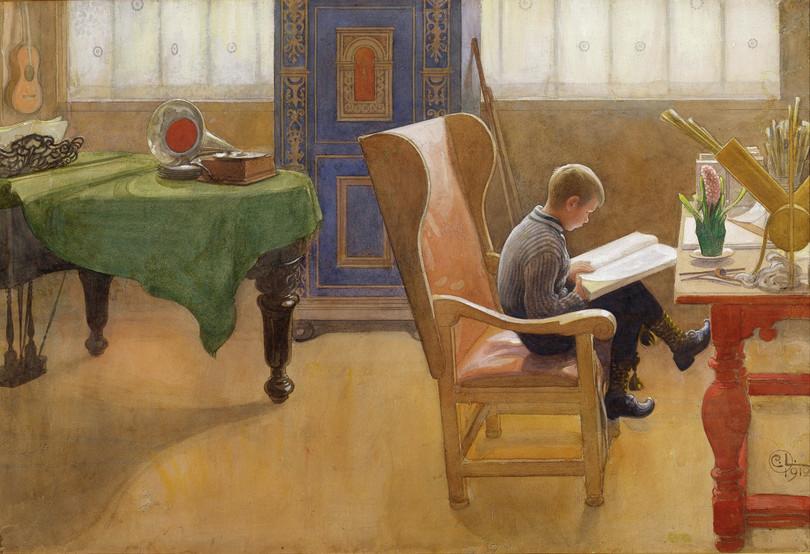 Image: ‘Esbjörn at the Study Corner’ (1912) by Carl Larsson.
The underlying reasons that I actually sit down and read a book are different. Now begins the solo journey into the story, mind engaged, time committed. A person might read a book because:
- they hope it will make them feel better, like a novel or a self-improvement book
- they feel obligated to read it: for example, when they’re expected to as a professional in their field.
- they’re forced to read it: their teacher said they must, for instance.
The reasons they read make a big difference to how they feel about the book, how they approach it, and how receptive they are to its story or message. Do they really want to read it? Do they trust it? What do they expect it will make them feel when they read it? Their excitement and apprehension set the bar that the book will have to meet if they are to finish reading it.
So selectors and readers are looking for different things. Even when they belong to the same human, the mind that selects and the mind that reads are after different rewards in different moments. Every book you buy and never read tells us this.
What does this mean for our work as publishers?
As writers and publishers, it’s crucial that we know who will select our books and who will read them, and whether or not that’s the same person. It will inform many of our decisions about the book, from writing and style through editing and design, to formats, marketing, and distribution.
There is also a subclass of selectors we can call champions: people you need on your side to get the book to its destination. Champions include people who fund your project up-front and all the decision makers who help carry the book downstream: fans, reviewers, retailers, and other partners. They must also select your book without being your target readers.
Selecting always involves paying a cost: where the book is for sale, that cost is largely financial. Even when there isn’t a financial cost (for example, the book is open access, in a library, or already paid for), selecting incurs an opportunity cost or a reputational risk (‘What will others think if I choose this?’). Selecting is an investment, and so there is resistance to making the decision.
The publisher’s first job is to overcome that resistance, by making the return on investment clear or immediate.
Reading also incurs an opportunity cost: every minute they read, the reader could be doing something else. They could put the book down at any time. We’ll come back to this.
In commercial publishing, pleasing the selector is critical for getting the book sold. And pleasing the reader helps make the next sale, either by satisfying the original selector (‘My students passed my class’), or turning the reader into a champion (‘I want to read the sequel!’, ‘You should also read this!’).
In strategic publishing, we must please champions and selectors in order to have any reach at all: even where we’re not selling copies, we still need funders, project managers, team leaders, teachers and trainers to select our book. At the same time, in order to make a strategic impact, we have to please readers. Not only that, but we need to change the way our readers think. Changing behaviour is the whole point of strategic publishing.
But remember: selectors and readers are motivated differently. They are looking for different things when they pay their costs. That’s easier to cater for when they are the same human, but if they are not, and especially if they are very different, we have to prioritise one or the other. In parts of our work selectors will matter most, and in other parts readers will. We have a difficult balance to strike, and we have to be very deliberate about where we spend time and money.
In concrete terms, where should we prioritise selectors versus readers?
As you might expect, the difference is between the surface and the interior.
- Promotional surfaces must prioritise the selector: the cover, website landing page, table of contents, and promotional media must appeal most to selectors. Credibility signals like branding and trust-by-association are critical. The product design must reward them: does the selector feel clever or important when they choose this book? Does selecting your book help them impress someone or meet a KPI? They must certainly never feel uncomfortable about selecting it, or about being seen to select it. They might never actually read the book, and that’s fine.
- The interior text and imagery must prioritise readers: they might have a different language level and discourse and prefer different kinds of imagery to their selector. While selectors might already agree with your book’s aims, readers for whom the book was chosen might not: they might need to be led more gently and subtly from their existing worldview to the new one your book is proposing. While promotional surfaces shouldn’t alienate readers, the selector has already done the work of putting the book into the reader’s hands – the reader only needs a nudge from the book’s surface to start them reading. After that, the text must feed them a constant stream of satisfaction in order to pay the ongoing opportunity cost of reading it. If we do that very well, our readers might become champions for the book, too, or even selectors.
If we’re good at what we do as strategic publishers, we know what our selectors need, and we know what our target readers need.
For example, an educational psychologist who publishes a booklet for pregnant teens should know what those teens need as well as or better than the clinic administrator who must choose to distribute it. Your promotional surfaces need to assure the administrator that they’re doing the smart thing by selecting it, but your text and imagery must speak directly to the pregnant teen.
The celebrity you ask to champion your book about gambling addiction won’t know as much as you do about families who suffer from that addiction and need to read your book. But that celebrity will care about what championing the book says about them, as expressed in the title, cover, and description.
Designing your promotional surfaces to appeal to selectors is not disrespectful to those people. They can’t be expected to engage as deeply with your message as you have done, or as your readers will. Rather, your promotional decisions should make it easy for them to get behind your book by understanding their needs and context.
So what must we do when planning a project?
- First, write down who your selectors are, and who your readers are. Create personae to represent them: one to three fictional but specific, fleshed-out characters that your team must visualise every time they make a decision.
- To secure the support of funders and other champions and selectors, invest in professional design and branding: work with someone experienced to design a selector-oriented book cover and landing page, testing one or more titles that appeal to them, and high-level messaging (book blurb, landing-page copy). When you get feedback, look for signs of excitement more than intellectual engagement: if you’re stirring emotions you’re on the right track. Emotions drive commitment.
- To prioritise readers, get a development editor to refine a chapter of your manuscript, prioritising your reader personae. Then test the chapter by asking real people, who match your reader personae, to read it and say what they liked and didn’t like about it. They will struggle to engage at a high level, and will want to please you, so look for subtle signs of reading friction, and clues about what works to lean into.
- Draft a promotional strategy that makes explicit whether your book’s selectors and readers are different people or mindsets, and what motivates each of them. This should be incorporated into all briefs to team members (editors, designers, developers, translators, etc.).
And the next time you’re looking at a book you admire, give some thought to how it pleases its selectors and readers. That probably didn’t happen by accident.